Financial Stability Council: Initial Progress in the Development of Sustainable Finance in Montenegro
18/02/2026
Today, the Financial Stability Council held 76th meeting, chaired by Irena Radović, the CBCG Governor and the Council Chair. The meeting was attended by Council members – Novica Vuković, Minister of Finance; Željko Drinčić, President of the Capital Market Authority; and Marko Ivanović, President of the Council of the Insurance Supervision Agency. At the invitation of the Governor, the newly appointed Director of the Deposit Protection Fund, Andrija Radunović, also attended the meeting.
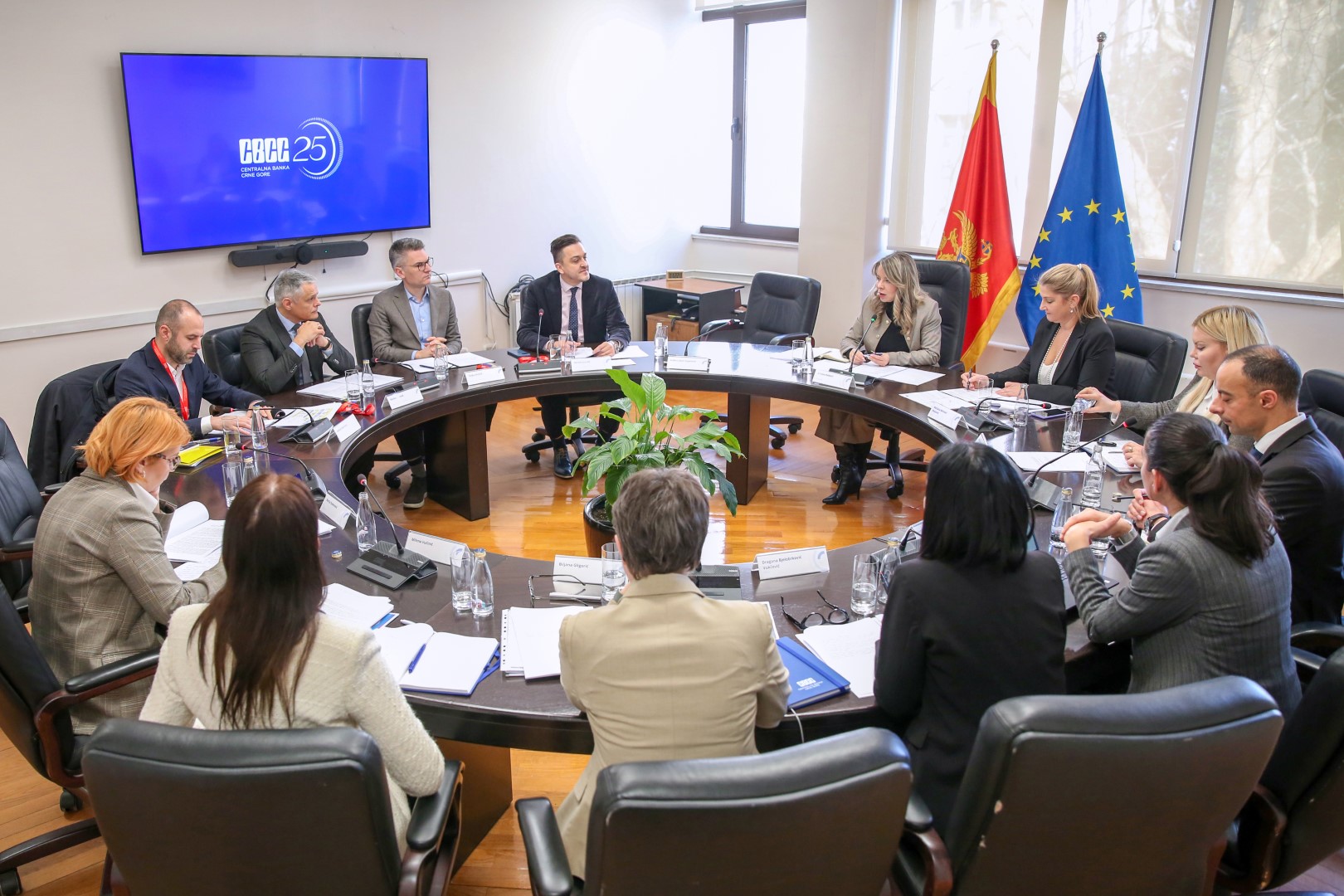
At today’s session, the Council discussed the Information on Financial Stability for the Fourth Quarter of 2025, noting that the Montenegrin economy recorded growth of 3.2% in the first nine months of 2025. Real sector indicators point to annual growth in retail trade and construction, while industrial production declined. In the period January–November, a slight increase in revenues from foreign tourists was recorded, although the number of overnight stays decreased by 1.4%, alongside an annual increase of 5% in tourist arrivals.
The Council analysed trends in public finances during 2025, with particular reference to the performance of budget revenues and expenditures, and the level of public debt.
The banking sector was characterised by positive trends, confirming its stability, liquidity and solvency, alongside continued deposit growth. Exposure to systemic risks at the end of 2025 was assessed as moderate, with risks of a cyclical nature identified, primarily linked to strong credit growth and rising real estate prices.
At the meeting, members also discussed the First Report on the Implementation of the Financial Sector Roadmap towards Sustainable Finance, adopted by the Council in March 2025, with the aim of gradually aligning Montenegro’s financial system with European and global sustainable development standards and ESG principles. The implementation of the Roadmap represents an important step towards bringing the domestic regulatory and supervisory framework closer to the standards applied by key European institutions, thereby further strengthening institutional preparedness for full integration into the European financial system.
The Report provides an overview of implemented activities, a qualitative assessment of progress in 2025, identifies key challenges and defines recommendations for the forthcoming period. It noted measurable progress in the first year of implementation, primarily in establishing governance and coordination mechanisms, strengthening institutional capacities, and preparing regulatory and methodological foundations for the further development of sustainable finance. A particular step forward was made in the banking sector through the adoption of guidelines for the management of ESG risks, while the capital market sector started preparations for the legislative framework governing the development of green and sustainable financial instruments. At the same time, activities in the insurance and pension fund sectors were aimed to strengthen climate risk management mechanisms. By providing a fiscal, regulatory and institutional framework for financing the green transition, the Ministry of Finance contributed to creating the conditions for directing public and private capital towards sustainable and green investments.
The Report saw key challenges in limited institutional and market capacities, the lack of comparable data, and the dynamic development of the European Union’s regulatory framework in the field of sustainable finance, which requires continuous adjustment at the national level. In the forthcoming period, the focus should therefore be placed on the operational application of developed frameworks and guidelines, the development of methodologies and tools for data collection and reporting, further capacity building through training and technical assistance, and improving the availability and quality of data. The importance of continued cooperation was emphasised, both at sectoral level and with regional and international partners, to facilitate knowledge transfer and the application of good practices, while taking into account the specific characteristics of the domestic financial system.
It was concluded that the implementation of the Roadmap to date confirms the Montenegrin financial system institutions’ commitment to the gradual development of sustainable finance, while the Report provides an important basis for further monitoring of progress and improving the implementation process.
Based on the data presented by the Deposit Protection Fund, it was assessed that the Fund has adequate capacity to perform its statutory responsibilities.
The Council concluded that the Montenegrin financial system remains stable, while emphasising the need for continued risk monitoring and further strengthening of the system’s resilience in a changing macroeconomic and regulatory environment.