First meeting of the Council of the CBCG was held
25/11/2016
Council of the Central Bank of Montenegro, chaired by Governor Radoje Žugić, held its first meeting today.
The Council adopted the Governor's Report on operations and implementation of the Central Bank of Montenegro's policy for September 2016, in which it was stated that the activities of the Central Bank in this period were carried out in accordance with the planned obligations determined by the Work Program of the Central Bank for 2016. The Council analysed and rated the influence of the potential risks from the macro-economic environment and from the financial system on the financial situation and found that the financial system is stable, with a moderate level of systemic risk.
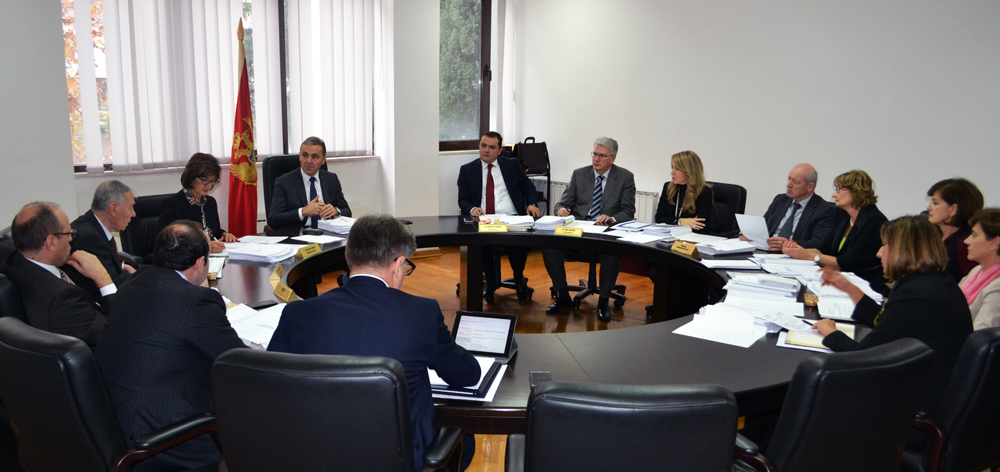
The Council adopted the Policy of the Central Bank of Montenegro for 2017, with the guidelines for its implementation. The Central Bank will, in the coming year, pursue a policy of monetary and financial stability based on taking all necessary actions and use all available instruments and measures under its jurisdiction, in order to strengthen confidence in overall financial system, improve the safety and soundness of the banking system, timely identification and minimize negative impacts. For the purpose of further enhancing and preserving of financial stability, the CBCG will develop components of the macro prudential framework; promote indicators for the evaluation of financial stability and the prevention of systemic risks and the instruments for their suppression. In order to strengthen the financial system, particularly focus will be on the promotion of stability of the banking system. In this context, the CBCG will continue to monitor and analyse the situation in the banking system, and, if necessary, take corrective measures, promote the strengthening of corporate governance and risk management in banks and continue with further implementation of internationally accepted standards and principles in this area. It will encourage the implementation of activities on the consensual financial restructuring of debts with financial institutions. Within its competences, the CBCG will continue harmonization of the regulatory framework and statistics with the EU acquis, and reporting obligations to the ECB.
The Council adopted the Financial plan of the Central Bank of Montenegro for 2017 with a plan of investments, public procurement and cash flows while continuing the implementation of measures of internal economy and active relations in the management of international reserves. The plan for 2017 was prepared on the basis on the execution of the financial plan of the Central Bank for the first nine months of 2016, and projections of expected financial income and expenses in the coming year.
The Council adopted the Quarterly report on the operations of banks and MFI as at 30 September 2016. It was noted that the operations of banks in the third quarter were characterized by the growth of assets, loans, deposits and capital. Indicators of liquidity and solvency were significantly above the prescribed level. Compared to the previous quarter, there was an improvement in all the parameters of asset quality. The financial result at the system level was positive and amounted to 23.7 million euros.
The Council adopted the Information on implementation of strategies and operational goals of banks to resolve non-performing loans in the third quarter of 2016. Analysing the efficiency of realization of the underlying strategies it was assessed that the banks were successful in restructuring, which resulted in a reduction in non-performing loans by 15.2% at the end of the third quarter of the current year. On the other hand, banks were less efficient when it comes to enforcement of nonperforming loans.
The Council adopted Recommendations to the Government of Montenegro for Economic Policy in 2017. The recommendations are aimed at minimizing the vulnerability of the economic system of Montenegro for the following areas: fiscal policy, financial system and the real sector statistics. The overall aim of the recommendations in the fiscal area is to increase budgetary discipline and making a credible plan for the repair of deficit and public debt. It was pointed out that the structure of expenditures of the budget should reflect the development priorities of the country and to monitor the dynamics of the revenue performance. Risk reduction and fiscal stability can be achieved only with balanced budget of current expenditure, while the potential deficit can only be planned for development projects and removing bottlenecks in the economy. The overall aim of the recommendations in the financial system is to preserve its stability, achieving smooth and stable functioning of all segments of the system, as well as an effective intermediation in the country. Recommendations in the area of real sector are aimed at increasing competitiveness, improving the institutional environment and promoting development in key sectors of the revaluation - tourism, energy, agriculture and manufacturing industry. In the area of structural reforms, recommendations are aimed at creating higher flexibility in the labour market, increasing the sustainability of the pension system and the system of social benefits and harmonization of education with the needs of the real sector and the labour market. Recommendations in the area of statistics aim to achieve full harmonization of official statistics with the EU acquis.