Fiscal Consolidation and Financial Policy Encouraging Results
16/10/2017
The Montenegrin delegation, including the Minister of Finance, Mr Darko Radunović, the Governor of the CBCG, Mr Radoje Žugić and Vice-Governor for Financial Stability and Payment System, Mr Nikola Fabris, met with the Vice-President of the World Bank for Europe and Central Asia, Mr Cyril Muller, Director of the World Bank for Southeast Europe, Ms Linda van Gelderand Head of IMF Mission to Montenegro, Mr Martin Petri on the first day of the annual meetings of the International Monetary Fund (IMF) and the World Bank, held from 13 to 15 October in Washington, D.C.
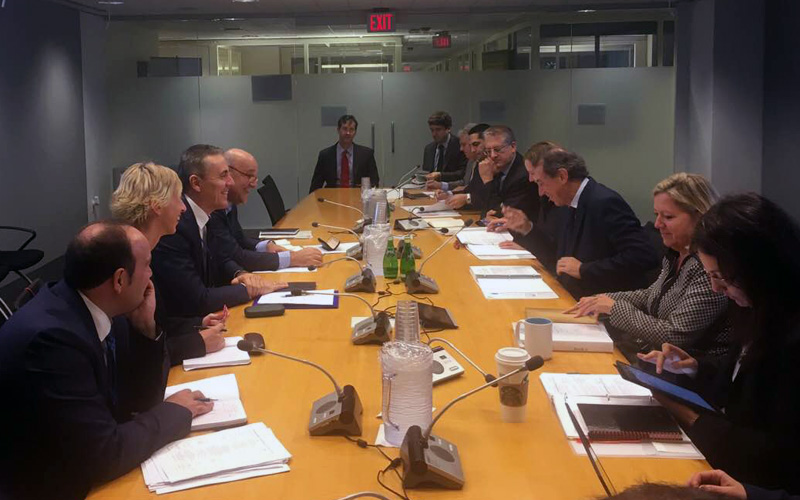
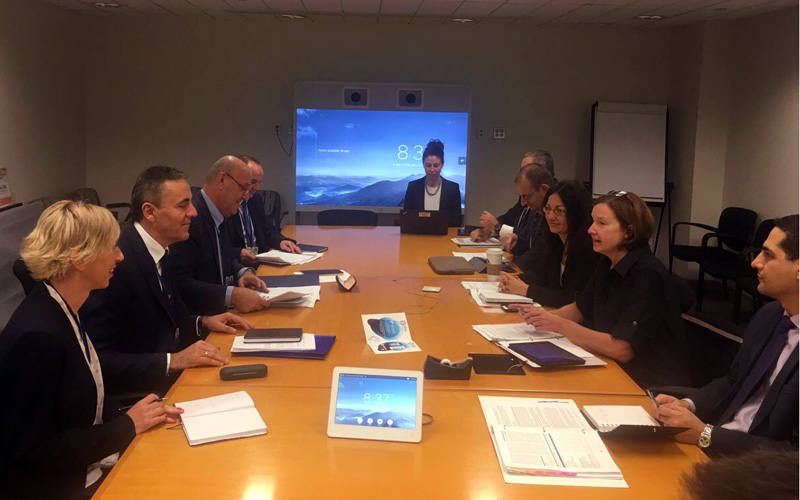
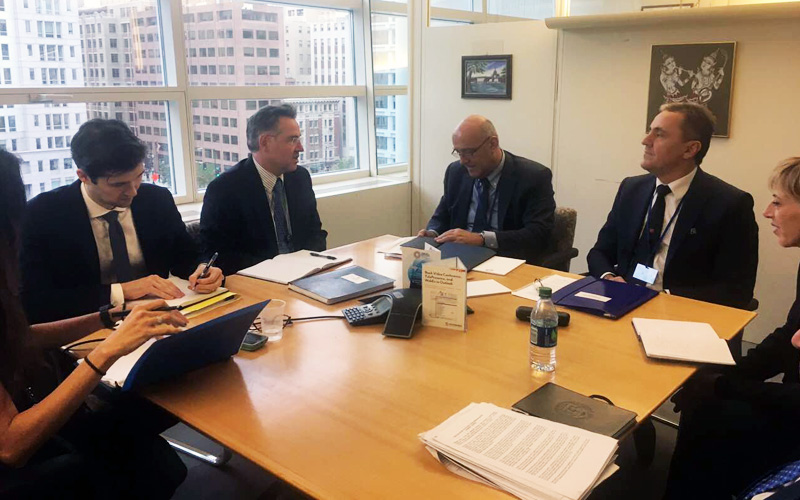
Encouraging and credible results of the Fiscal Strategy, as well as the financial system, which was assessed as relatively stable and secure, were discussed at a meeting with Mr Muller and Ms Van Gelder. It was concluded that the recorded progress in economic policy created preconditions for efficient debt management, while an effectively implemented Fiscal Strategy ensures the sustainability of public debt in the medium term. Vice President Miller emphasized that the government made significant progress in improving the fiscal position and strengthening financial stability, reflected through the record growth of the economy in 2017 and improving its macroeconomic prospects by the prominent credit rating agencies. Financial stability has been enhanced and supported through the strengthening of the balance sheet, the recovery of lending and a significant decline in non-performing loans. With liquidity and solvency ratios at the level significantly above the legally prescribed minimum and a strong growth in credit activity, the banking system proves to be stable, solvent and highly liquid.
Significant progress of Montenegro in meeting the World Bank's priority activities for receiving support in the amount of USD 90 million guarantee was appreciated, which would contribute to Montenegro's more favourable access to international capital markets, as well as the stabilization of public debt. Real expectations are that this arrangement will be completed by the end-2017.
The idea of additional financing of the highly successful MIDAS project, in preliminary amount of a roughly USD 34 million was supported at the meeting with the Vice President Muller, which would provide additional support to the development of agricultural capacities and strengthening of the food safety system.
A strong growth in the first half of 2017 and the positive effects of the measures adopted within the framework of the Recovery Plan and Fiscal Strategy were discussed at the meeting with Mr Martin Petri, Head of the IMF Mission to Montenegro. The Montenegrin delegation showed appreciation to the IMF team for their support and quality recommendations, which were the grounds for forming a credible fiscal consolidation agenda, as well as for improving financial policy. On this occasion, the members of the Montenegrin delegation emphasized Montenegro's commitment to continuing the implementation of measures, which will contribute to the reversal of the public debt trend in the medium term. Technical assistance with the aim to continue implementing mid-term debt management strategy was also arranged with the IMF.
The Head of Mission confirmed that significant progress was made in the implementation of the 2016 FSAP (IMF and World Bank Financial Sector Assessment Program) mission recommendations. Specifically, intensive activities to improve the regulatory framework resulted in the preparation of a set of laws in the previous period, those including (i) the Central Bank Law, which is fully in line with the Treaty on the Functioning of the European Union and the Statute of the ESCB and of the ECB; (ii) the Law on Amendments to the Banking Law; and (iii) Bank Resolution and Recovery Law, implementing the Bank Recovery and Resolution Directive; and (iv) the Law on Financial Institutions, which provides for the regulation and supervision of the most important non-banking institutions by the CBCG, that will reduce the potential risk of their business to financial stability.
As the discussions continued, opinions on the 2018 Budget Plan, as well as on the modalities of reducing the non-observed economy through digital fiscalization were exchanged.