The IMF and the World Bank remain Montenegro’s strong and reliable partners
13/10/2022
As part of the International Monetary Fund (IMF) and the World Bank (WB) Annual Meetings, the Montenegrin delegation led by the Governor of the Central Bank of Montenegro (CBCG), Radoje Žugić, and the Minister of Finance, Aleksandar Damjanović, met with the Deputy Managing Director at the IMF of the IMF, Bo Li, and this institution’s Executive Director Paul Hilbers.
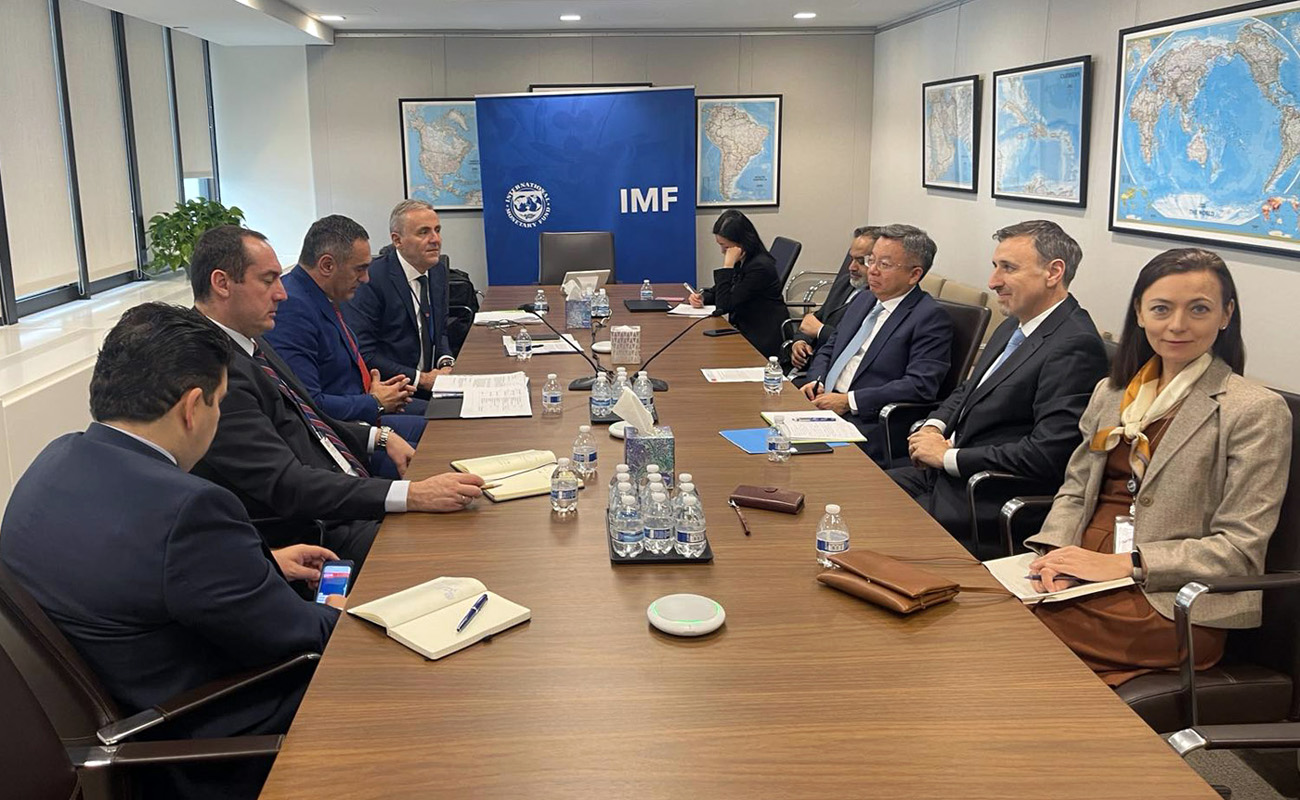
At the said meetings, Governor Žugić and Minister Damjanović presented Montenegro’s current macroeconomic, fiscal and financial position.
Governor Žugić pointed out that, despite the unfavourable macroeconomic environment and exposure to numerous risks, Montenegro’s financial system stability has been preserved and further improved owing to the positive trends characterising the banking operations in the period before the pandemic and to the efficient and proactive CBCG actions.
“In the previous, extremely challenging time, we actively worked on supervision capacity strengthening and preventing money laundering, thus transforming the former vulnerabilities into our great advantage today,” said Žugić. The results of the banks’ Asset Quality Review (AQR), carried out by independent external auditors following the ECB methodology, confirmed the banking sector’s stability, the Governor pointed out. He added that the domestic regulatory framework governing banking operations is almost completely harmonised with EU directives, and we are working intensively on payment system improving.
Minister Damjanović said that the Government of Montenegro was putting the utmost effort to ensure that Montenegro’s small, open and dependent economy was responsible and ready to cope with the current and upcoming global challenges (such as the growing inflation and the future energy crisis) to create a more stable and predictable economic context.
Concerning the Montenegrin public finances’ objective state and plans for their stabilisation, Minister Damjanović emphasised that the Government was trying to define concrete measures aimed at faster economic growth and development as prerequisites for macroeconomic and fiscal stability within the priority objectives framework. In this sense, Damjanović pointed out that economic growth projections for the current year will be corrected positively, which hints that the Montenegrin economy and finance are on the path of complete consolidation.
In addition to discussing Montenegro’s development goals and compliance with the Partnership Framework for Montenegro 2023-2027, the issues discussed at the Washington meetings included the possibilities available to the state as an IMF member. These possibilities currently do not include financial, but rather technical and advisory support and space for the experience exchange, and providing specific guarantees in possible financial arrangements with numerous banking and financial institutions.
Central Bank of Montenegro and the Ministry of Finance