Thirty-first CBCG Session Held
07/09/2018
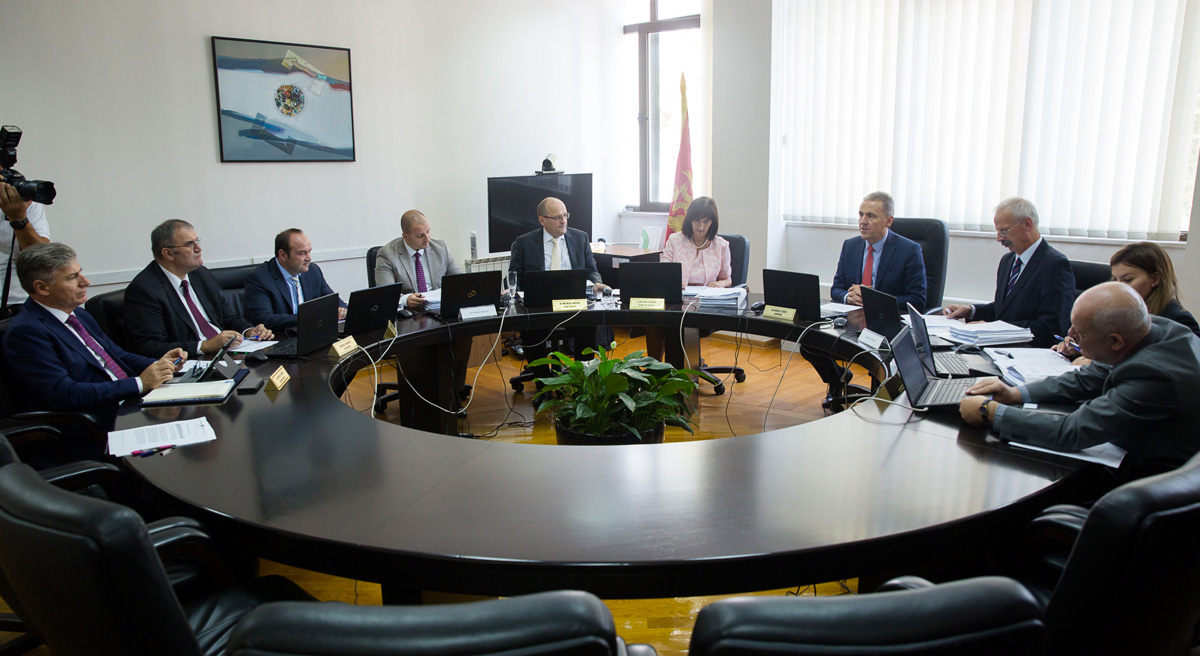
The Council of the Central Bank of Montenegro held today its thirty-first session, chaired by the Governor, Radoje Žugić.
The Council discussed and adopted the Reports on operations and on the implementation of the CBCG policy for May, June and July 2018, which state that the activities of the Central Bank during this period were realized in accordance with the planned commitments established by the Central Bank's Work Program in 2018.
The Council adopted a Decision on reproduction of banknotes regulating reproduction requirements for euro banknotes as a legal tender in Montenegro. By adopting this Decision, the ECB's Decision on the denominations, specifications, reproduction, exchange and withdrawal of euro banknotes (ECB / 2013/10) was fully implemented in the part relating to the reproduction of euro banknotes.
In order to fully comply national regulations with new and/or innovated EU regulations, in the part of securing the protection of the euro against counterfeiting, the Council adopted the Decision Amending the Decision on medals and tokens similar to euro coins, Decision Amending the Decision on the handling of suspect euro notes and coins and other activities aimed at protecting the euro against counterfeiting and Decision Amending the Decision on authenticity and fitness checking and recirculation of euro notes and coins.
The Council also discussed the Macroeconomic Report of the Central Bank of Montenegro (Q1 2018). The Report pointed out that in the first quarter of 2018, the Montenegrin economy, according to the preliminary data of MONSTAT, grew by 4.5%. Positive trends were recorded in almost all sectors, with particular emphasis on construction, tourism and industrial production, where after the fall in 2016 and 2017, growth was recorded in the first quarter of 2018 (39%) if compared to the same period of 2017. The largest contribution to the growth of industrial production was provided by the strong growth recorded in the electricity supply sector. The Report also noted that the banking sector in Montenegro is characterized by stability, liquidity and solvency. The non-performing loans amounted to 200.4 million euros at the end of March 2018 and accounted for 7.3% of total loans. At the annual level, their fall was 19.3%.
In the Inflation Report (Q1 2018), consumer prices continued to rise in the first quarter of the current year, continuing the trend from 2017. This trend is a consequence of the increase in excise duties on tobacco products, the rise in oil prices on the global level, which also affected the rise of fuel prices in Montenegro, as well as an increase in the VAT rate. As for the inflationary expectations, a survey conducted by the CBCG shows that most banks expect inflation in the range of 2.5% to 3%, while the largest number of respondents expect inflation in the range of 2% to 2.5%. According to the CBCG's expert projection, inflation will range from 1.9% to 3.9% in 2018 with a central projection of 2.9%.
At today's session, the Council also discussed other current issues from the domain of its competence.