Governor Radović meets Head of EBRD Office in Montenegro: Strengthening Partnership for a More Competitive and Inclusive Montenegrin Economy
04/11/2026
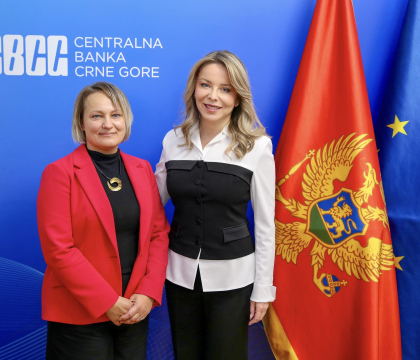
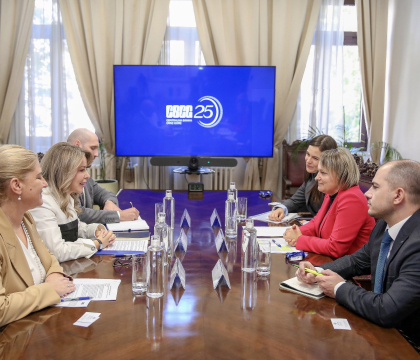
The CBCG Governor Irena Radović, met the newly appointed Head of the Office of the European Bank for Reconstruction and Development (EBRD) in Montenegro, Ekaterina Solovova. During the meeting, they discussed further enhancing cooperation between the two institutions, with a focus on strengthening financial inclusion, access to finance for businesses, the economic empowerment of women and the competitiveness of the Montenegrin economy.
Governor Radović congratulated Ms Solovova on her appointment and expressed satisfaction with the partnership between the CBCG and the EBRD to date, which has produced specific initiatives and internationally recognised results.
‘Our partnership with the EBRD shows that by working together we can achieve results that go beyond individual projects. Our goal is for the financial system to be not only stable and resilient, but also a strong driver of sustainable economic development, creating more opportunities for entrepreneurs, women and young people, as well as for businesses in all parts of Montenegro,’ said Governor Radović.
Attention was given to the EBRD’s new Strategy for Montenegro for 2026–2031, whose priorities are improving economic governance, strengthening private sector competitiveness, the green transition and better economic connectivity. It was assessed that these goals open additional scope for cooperation, particularly in the context of Montenegro’s progress towards EU membership.
Speaking about results to date, the Governor highlighted the WE Finance Code Montenegro initiative, which the CBCG coordinates with EBRD support. The initiative has established a national coalition of 28 institutions, with signatory banks accounting for 93% of the banking sector’s total assets. The CBCG has also developed a publicly available interactive platform that allows closer monitoring of access to finance for women-owned businesses.
For the results achieved in this area, the CBCG received international recognition at the WE Finance Code Global Forum in Paris in October 2026.
‘We are especially proud that, with the support of our partners, we have established a system that enables us to make financial inclusion decisions based on reliable data. Our next goal is to turn that data into specific financial products and even greater access to finance for women entrepreneurs,’ said the Governor.
Discussions also covered the possibilities for wider use of innovative credit risk-sharing instruments (Portfolio Risk Sharing), which, with EBRD support and EU guarantees, enable banks to increase lending to MSMEs. The potential of these instruments for financing women’s and youth entrepreneurship, green investments and business activity in less developed areas was given consideration.
They also reviewed the joint Women on Boards programme, which has contributed since 2023 to increasing the representation of women in governance and leadership positions. They highlighted the importance of further developing the programme, with the aim of linking the knowledge and competencies acquired even more closely to specific opportunities for women to take part in economic decision-making.
The discussion also noted the importance of high standards of corporate governance, transparency of ownership structures, investor integrity and responsible risk management, as shared principles that contribute to confidence in the financial system and its long-term stability.
Governor Radović also pointed to the importance of the European integration of Montenegro’s financial system, particularly through accession to the SEPA area and the development of instant payments, underlining that the modernisation of financial infrastructure should be accompanied by wider availability of financial services and stronger support for economic development.
The meeting confirmed readiness to continue close cooperation between the CBCG and the EBRD, while considering new initiatives that would help to expand access to finance, strengthen corporate governance and promote the sustainable development of the Montenegrin economy.
‘We want to measure the success of our partnership by tangible results – the number of businesses supported, new economic opportunities for women and young people, and a contribution to a more competitive and resilient Montenegrin economy. I believe that, together with the EBRD, we will continue to build precisely that kind of partnership,’ concluded Governor Radović.